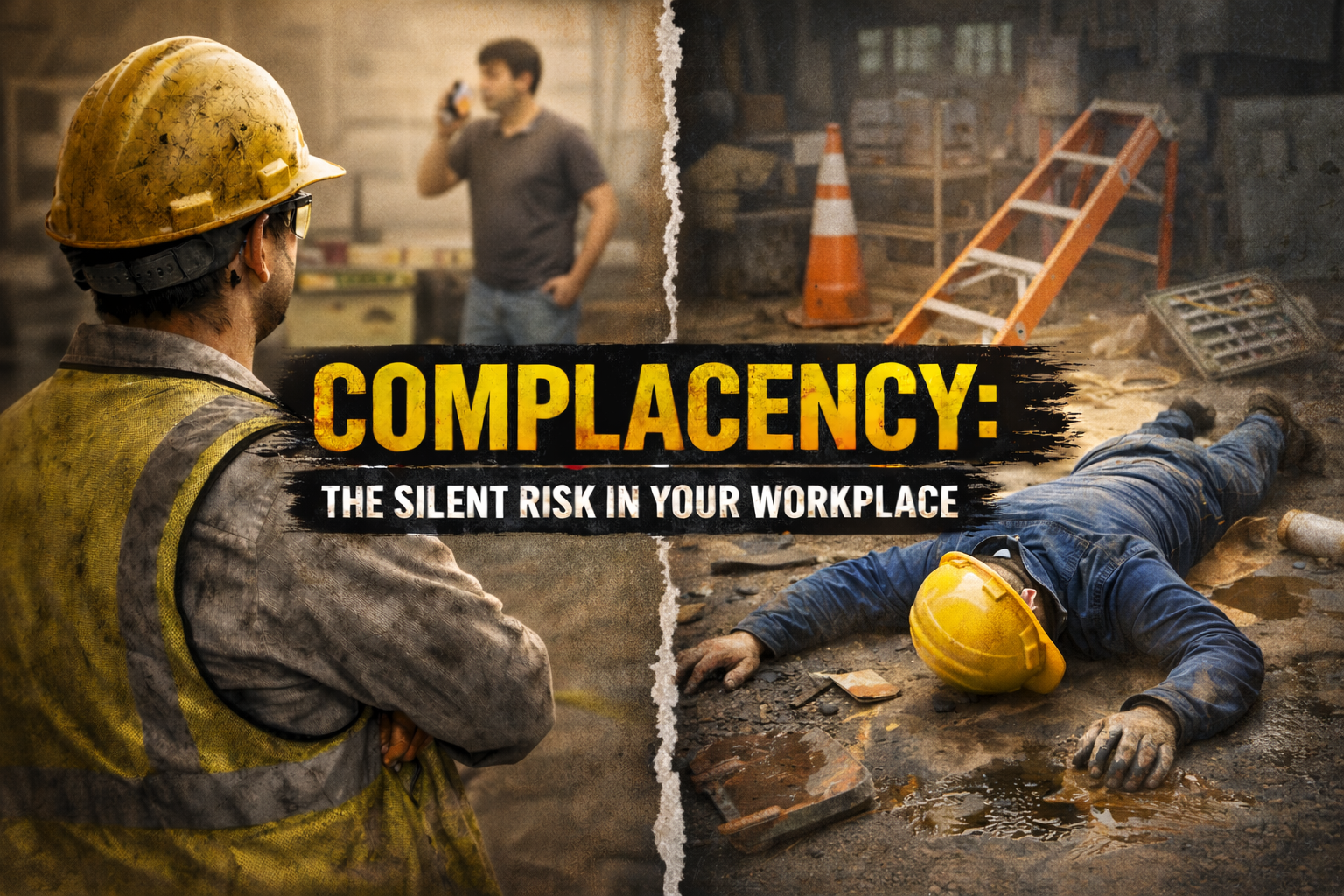
Complacency is one of the most persistent and least recognized risks in the modern workplace. Unlike a missing guard or an unprotected edge, it does not present itself as an obvious hazard. It develops gradually embedded in routine, reinforced by repetition, and often masked by experience.
At its core, complacency is not a failure of knowledge. It is a loss of awareness.
In many organizations, safety efforts are heavily focused on identifying and mitigating physical hazards. While this work is essential, it can create a false sense of security if behavioral risks are not given equal attention. Over time, as employees perform the same tasks without incident, familiarity begins to replace vigilance. The job feels safe, not because the hazards have been eliminated, but because they have become normalized.
Data continues to reinforce this reality. The same categories of workplace incidents (falls, struck-by events, caught-in or between hazards, and electrical exposures) remain among the most frequently cited by the Occupational Safety and Health Administration (OSHA) year after year. These are not emerging risks or unknown conditions. They are well understood across industries, and in most cases, employees have been trained to recognize them.
Yet they persist.
The explanation lies not in a lack of information, but in the way individuals and organizations interact with that information over time. Repeated exposure to risk without consequence creates a perception that the risk is lower than it truly is. This perception subtly influences decision-making. Steps are skipped. Shortcuts are taken. Procedures become suggestions rather than requirements. None of these actions are typically driven by intent to disregard safety; rather, they are the natural result of familiarity and efficiency gradually overtaking discipline.
Experience, while valuable, can amplify this effect. Seasoned employees often develop a level of confidence that allows them to perform tasks more efficiently, but that same confidence can lead to assumptions. Tasks are completed from memory instead of procedure. Hazards that were once recognized are now overlooked. The work becomes automatic, and with that automation comes reduced situational awareness.
It is important to recognize that incidents rarely occur during unfamiliar or complex tasks. More often, they occur during routine operations, the very activities that employees perform every day. These tasks carry a high level of exposure simply due to their frequency, and when combined with reduced awareness, they create conditions where a single deviation can result in significant consequences.
Addressing complacency, therefore, requires more than additional training or stricter enforcement. It requires a shift in how organizations approach safety at a cultural level. Complacency thrives in environments where production pressures consistently outweigh safety considerations in practice, where minor hazards are tolerated rather than corrected, and where the absence of incidents is interpreted as evidence of effective control. In these settings, risk becomes embedded in the way work is performed.
Effective organizations take a different approach. They recognize that maintaining safety is not a static achievement, but an ongoing process that requires active engagement. Leadership plays a critical role in this effort. When supervisors and managers remain present in the field, ask thoughtful questions, and challenge routine behaviors, they help reintroduce awareness into daily operations. They create an environment where employees are encouraged to think critically about their work rather than simply execute it.
One of the most practical ways to begin addressing complacency is through intentional conversation. Rather than focusing solely on rules or compliance, organizations should encourage dialogue around routine tasks. Asking a simple question, such as what could go wrong during a task that is performed every day, can reveal gaps that have gone unnoticed. These conversations shift the focus from enforcement to engagement and help employees reconnect with the risks inherent in their work.
Complacency is not an indication of a weak workforce or a failed safety program. It is a predictable human response to repetition and familiarity. However, if it is not actively managed, it can quietly erode even the most well-designed systems. Organizations that are successful in managing this risk are those that remain attentive, adaptive, and willing to challenge their own assumptions. They understand that safety is not maintained by policies alone, but by the behaviors and decisions that occur on the floor each day.
The question is not whether complacency exists within a workplace. The question is whether it is being recognized and addressed, before it leads to an incident.
Where have you seen complacency impact safety in your organization or industry?